Today’s Passage: Matthew 18:21-35
Peter approaches Jesus with a math problem. He wants a firm limit on forgiveness, a quota to meet before he can rightfully hold a grudge. He offers a number he considers generous. Jesus answers with a story about two servants and two ledgers. By the time Jesus finishes, Peter’s quota vanishes. The verdict becomes clear: you forgive because the King already canceled a debt you could never pay.
Matthew 18:21-22 (BSB)
²¹ Then Peter came to Jesus and asked, “Lord, how many times shall I forgive my brother who sins against me? Up to seven times?” ²² Jesus answered, “I tell you, not just seven times, but seventy-seven times!
Peter thinks seven times stretches the bounds of human mercy. Jesus replies with a number so massive it breaks the accounting system. Jesus commands Peter to lay down the ledger. You stop counting the offenses.
Matthew 18:23-26 (BSB)
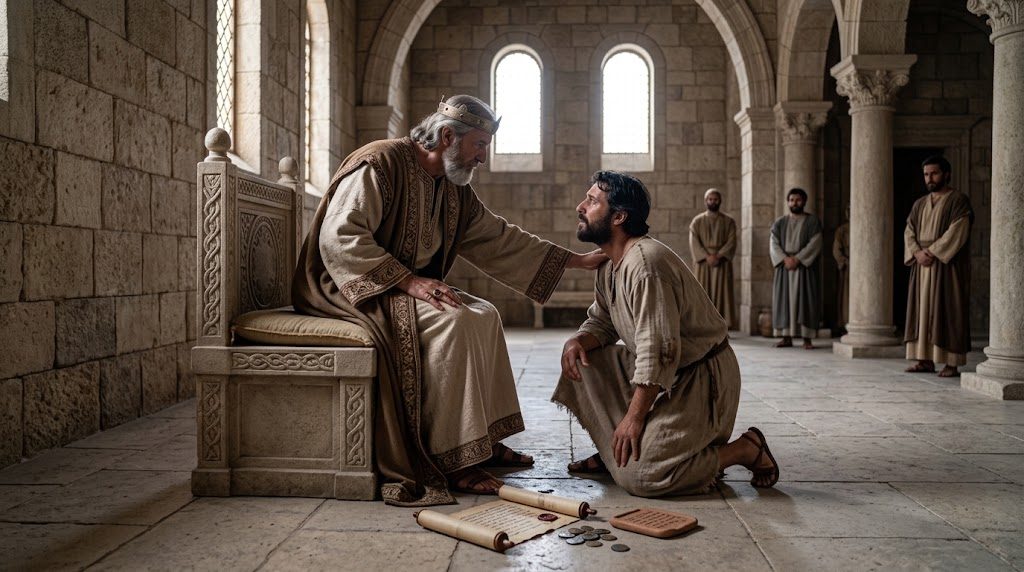
²³ Because of this, the kingdom of heaven is like a king who wanted to settle accounts with his servants. ²⁴ As he began the settlements, a debtor owing ten thousand talents was brought to him. ²⁵ Since the man was unable to pay, the master ordered that he be sold to pay his debt, along with his wife and children and everything he owned. ²⁶ Then the servant fell on his knees before him. ‘Have patience with me,’ he begged, ‘and I will pay back everything.’
A king audits his servants. Guards bring in a man owing an astronomical sum. The man lacks the funds. The king applies the law of the day, ordering the servant, his family, and his possessions sold to cover the deficit. The servant falls to the stone floor. He begs for an extension. He promises to repay the entire sum. That promise rings hollow. A single man could never earn enough in a lifetime to balance this scale.
Matthew 18:27 (BSB)
²⁷ His master had compassion on him, forgave his debt, and released him.
The king looks at the kneeling man. He acts with sudden compassion. He cancels the entire debt. He absorbs the massive financial loss himself and lets the servant walk out a free man.
Matthew 18:28-30 (BSB)
²⁸ But when that servant went out, he found one of his fellow servants who owed him a hundred denarii. He grabbed him and began to choke him, saying, ‘Pay back what you owe me!’ ²⁹ So his fellow servant fell down and begged him, ‘Have patience with me, and I will pay you back.’ ³⁰ But he refused. Instead, he went and had the man thrown into prison until he could pay his debt.
The servant who was just aphiēmi, pronounced af-EE-ay-mee. Strong's G863, to send away, release, let go completely. This word means to send a debt away for good, to let it go completely. It appears when a judge cancels a penalty and the debtor walks free. The financial loss remained real. The king simply chose to bear the cost himself. everything leaves the throne room. He immediately finds a colleague who owes him a few coins. He grabs the man by the throat. He demands immediate payment. The second man falls down and pleads for time using the exact words the first servant used moments earlier. The first servant ignores the plea. He throws his debtor into a cell.
Context Two debts, worlds apart
To understand the evidence Jesus presents, look at the historical currency. A single talent equaled twenty years of a laborer’s wages. Ten thousand talents amounted to two hundred thousand years of manual labor. No human being could earn that amount in a hundred lifetimes. The king erased a mountain of unpayable debt.
The second debt involved a denarius, a single day’s pay. A hundred denarii equaled about three months of wages. This represented a genuine financial hardship, but a man could pay it back with steady work.
Jesus builds a stark contrast. The unpayable debt belonged to the servant. The payable debt belonged to his colleague. The servant received total amnesty for a sum he could never earn back. He then weaponized the law against a man who owed him a fraction of that amount.
Matthew 18:31-34 (BSB)
³¹ When his fellow servants saw what had happened, they were greatly distressed, and they went and recounted all of this to their master. ³² Then the master summoned him and said, ‘You wicked servant! I forgave all your debt because you begged me. ³³ Shouldn’t you have had mercy on your fellow servant, just as I had on you?’ ³⁴ In anger his master turned him over to the jailers to be tortured, until he should repay all that he owed.
The other servants witness this hypocrisy. They report the incident to the king. The king summons the forgiven man back to the throne room. He asks a piercing question: Should you not have shown your fellow servant the same mercy I showed you? The king carried the unpayable debt himself. He refuses to watch that mercy die in the hands of a hypocrite.
Matthew 18:35 (BSB)
³⁵ That is how My heavenly Father will treat each of you unless you forgive your brother from your heart.”
Study notes The same kindness you received
Jesus directs this warning to anyone who accepts God’s forgiveness and refuses to extend it to others. Paul confirms this exact sequence in his letter to the church in Ephesus.
"Be kind and tenderhearted to one another, forgiving each other just as in Christ God forgave you." Ephesians 4:32 (BSB)
The sequence remains fixed. God’s forgiveness of you happens first. Your forgiveness of others flows out of that reality. You forgive out of the massive pardon you already possess.
The king demands that his servant remember his own pardon. A person freed from an unpayable debt must extend that same freedom to others. Identify one person you currently keep score against. Take one concrete step today to close that account. Delete the mental tally, send a kind word, or quietly say “I forgive you” to God, even if the person never hears it.
Pray to Close
Go to God and confess any specific debts you continue to hold against others. Thank Him for absorbing the massive cost of your own sin when you had no way to balance the scales. Ask Him for the strength to yield your right to be repaid, so you can truly let those offenses go.
Worship for Today
Forgiveness · Matthew West
This song grew out of a true story of costly mercy, and it never pretends the choice is easy or automatic. It sings about releasing someone who could never repay the loss they had caused, which is the very shape of today’s parable. Forgiveness is real precisely because the debt was real.
Listen: