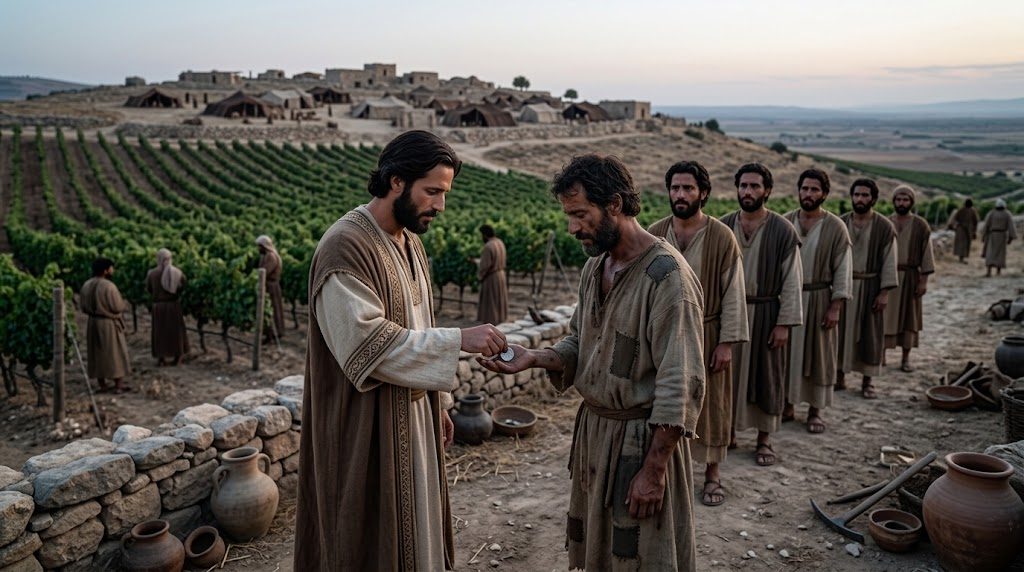
Today’s Passage: Matthew 20:1-16
Jesus tells a parable about a landowner who hires vineyard workers at different hours of the day. At sunset, every worker receives the exact same wage. The early workers protest the payment. You will see an immediate truth in this text: God’s generosity operates completely outside human scoreboards.
Context A day's wage
First-century day laborers lacked steady employment. Each morning they gathered in the marketplace to wait for landowners seeking hired hands. A denarius constituted the standard wage for one full day of labor. The dawn workers agreed to this exact payment before they picked up a single tool.
Matthew 20:1-2 (BSB)
¹ “For the kingdom of heaven is like a landowner who went out early in the morning to hire workers for his vineyard. ² He agreed to pay them a denarius for the day and sent them into his vineyard.
Jesus begins with a standard agricultural contract. A landowner needs laborers for his vineyard. He goes out at sunrise to hire them. The landowner and these first workers negotiate and agree on a fair wage before anyone steps into the field.
Matthew 20:3-7 (BSB)
³ About the third hour he went out and saw others standing in the marketplace doing nothing. ⁴ ‘You also go into my vineyard,’ he said, ‘and I will pay you whatever is right.’ ⁵ So they went. He went out again about the sixth hour and the ninth hour and did the same thing. ⁶ About the eleventh hour he went out and found still others standing around. ‘Why have you been standing here all day long doing nothing?’ he asked. ⁷ ‘Because no one has hired us,’ they answered. So he told them, ‘You also go into my vineyard.’
The landowner makes multiple trips to the marketplace. He returns at nine, at noon, at three, and finally at five. Each time he finds unemployed men. Each time he sends them into his vineyard with a promise to pay them whatever is right.
Matthew 20:8-10 (BSB)
⁸ When evening came, the owner of the vineyard said to his foreman, ‘Call the workers and pay them their wages, starting with the last ones hired and moving on to the first.’ ⁹ The workers who were hired about the eleventh hour came and each received a denarius. ¹⁰ So when the original workers came, they assumed they would receive more. But each of them also received a denarius.
The payment sequence reveals the landowner’s character. He instructs his foreman to pay the newest workers first. Each man receives a full day’s wage for a single hour of work. The dawn workers watch this exchange and immediately calculate that they will receive a larger sum.
Matthew 20:11-13 (BSB)
¹¹ On receiving their pay, they began to grumble against the landowner. ¹² ‘These men who were hired last worked only one hour,’ they said, ‘and you have made them equal to us who have borne the burden and the scorching heat of the day.’ ¹³ But he answered one of them, ‘Friend, I am not being unfair to you. Did you not agree with me on one denarius?
The dawn workers endured twelve hours in the scorching sun. Now they hold the exact same silver coin as men who worked one hour in the cool evening. They lodge a formal complaint. The landowner responds with facts. He calls the man a friend, and he points directly to the binding contract they established at sunrise.
Matthew 20:14-15 (BSB)
¹⁴ Take your pay and go. I want to give this last man the same as I gave you. ¹⁵ Do I not have the right to do as I please with what is mine? Or are you envious because I am generous?’
The landowner fulfilled his obligation entirely. He honored his word to the letter. The conflict arose because the first worker’s eye turned ponēros, pronounced poh-nay-ROS. Strong's G4190, evil, bad, morally corrupt. The Greek term literally describes an “evil eye.” It indicates a resentful disposition that looks at a neighbor’s blessing with greed. The worker stopped examining his own payment and started scrutinizing another man’s pocket. .
Matthew 20:16 (BSB)
¹⁶ So the last will be first, and the first will be last.”
Jesus delivers a final verdict on the kingdom of heaven. God issues grace on His own terms. His economy operates on unmerited favor, bypassing the merit-based ledgers humanity uses to keep score.
Study notes Every good gift
Comparison directs human attention toward a neighbor’s ledger. James directs human attention toward the Creator.
"Every good and perfect gift is from above, coming down from the Father of the heavenly lights, with whom there is no change or shifting shadow." James 1:17 (BSB)
God authors every legitimate blessing. The measure of His goodness to you remains independent of His generosity to anyone else.
The dawn workers received exactly what they bargained for. The landowner withheld absolutely nothing from them. Their joy vanished the moment they compared their wages to their neighbor’s hands. You can break the habit of comparison today. Identify one person whose recent success or blessing you have quietly measured against your own life. Reach out to them with a clear message, and tell them you are genuinely glad for their good news.
Pray to Close
Talk to God about the specific times you have allowed comparison to rob you of gratitude. Ask Him to help you evaluate your life without lining it up against anyone else’s circumstances. Thank Him for the exact provisions He has placed in your hands today, both seen and unseen.
Worship for Today
Jireh · Elevation Worship & Maverick City Music
This song identifies God as Jireh, the God who provides. It builds a case on a single theological fact: God is enough. You can stand firmly on this exact truth today, resting completely in the Father’s sufficient generosity.
Listen: