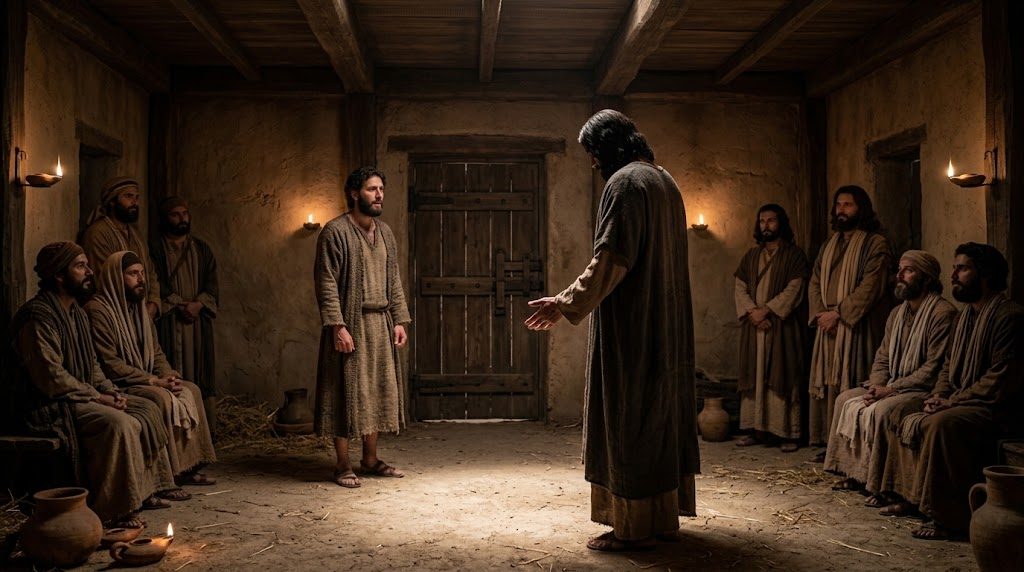
Today’s Passage: John 20:24-29
It is the evening of the first Easter week. Jesus has already visited the disciples once, appearing in a locked room to show them His hands and His side. One disciple missed that event, and he refused to take the testimony of the others. Jesus answers this skepticism with physical evidence, offering His wounds to establish the truth rather than using shame.
Context A demand for proof
Thomas was absent the first time Jesus appeared. The other ten disciples saw the risen Christ with their own eyes and testified to Thomas. He rejected their report. He demanded to see the nail marks himself. This is a man demanding verifiable proof. He wants to touch the physical wounds the others had already examined.
John 20:24 (BSB)
²⁴ Now Thomas called Didymus, one of the Twelve, was not with the disciples when Jesus came.
John records a simple fact. Thomas missed the initial presentation of the evidence.
John 20:25 (BSB)
²⁵ So the other disciples told him, “We have seen the Lord!” But he replied, “Unless I see the nail marks in His hands, and put my finger where the nails have been, and put my hand into His side, I will never believe.”
Thomas sets a clear standard for his belief. He demands empirical evidence: proof he can see and touch for himself. He draws a line in the sand based on physical reality.
John 20:26 (BSB)
²⁶ Eight days later, His disciples were once again inside with the doors locked, and Thomas was with them. Jesus came and stood among them and said, “Peace be with you.”
A full week passes. Thomas continues to meet with the others while carrying his skepticism. He stays in the room. Jesus arrives again, passing through a locked door, and offers the same greeting of peace.
John 20:27 (BSB)
²⁷ Then Jesus said to Thomas, “Put your finger here and look at My hands. Reach out your hand and put it into My side. Stop doubting and believe.”
Jesus confronts Thomas with the exact evidence he demanded. He offers His physical body for cross-examination. He commands Thomas to stop doubting and believe. The physical wounds provide the verdict, and Jesus calls Thomas to make a decision based on the facts before him.
Word study "Stop doubting and believe": *apistos* / *pistos* (John 20:27)
Greek: ἄπιστος (apistos) and πιστός (pistos), pronounced ah-PEE-stos and pee-STOS. Strong’s G571 and G4103.
Jesus places two distinct words side by side. Apistos means lacking trust. Pistos means full of trust. He defines the two choices facing Thomas. He then presents His own wounds as the bridge from skepticism to conviction.
Jesus supplies the physical proof Thomas required. The evidence stands right in front of him, ready for inspection.
John 20:28 (BSB)
²⁸ Thomas replied, “My Lord and my God!”
Thomas abandons his demands. Confronted with the resurrected Christ, he delivers his verdict immediately. He calls Jesus his Lord and his God. He reaches the only logical conclusion the evidence allows, resulting in total surrender.
John 20:29 (BSB)
²⁹ Jesus said to him, “Because you have seen Me, you have believed; blessed are those who have not seen and yet have believed.”
Jesus affirms Thomas’s conclusion and extends a blessing to you. Thomas required physical sight to believe. You are invited to examine the historical record and believe without seeing the physical body. Both responses rely on the same grace and the same truth.
Study notes The purpose of the record
John explains the purpose of recording this event. A few verses later, he states the objective of his entire Gospel.
"But these are written so that you may believe that Jesus is the Christ, the Son of God, and that by believing you may have life in His name." John 20:31 (BSB)
The historical record of these wounds exists to produce belief. The evidence is presented so you will examine it, accept the verdict, and find life in Christ.
Thomas demanded evidence, Jesus presented Himself, and Thomas worshiped. That is a straight line to the truth. Bring your own honest question into the light today. Speak it out loud to one other believer. Ask that person to pray with you as you seek the facts. Carry your doubt into the open, and let the evidence lead you to worship.
Pray to Close
Come to God with the questions you are carrying, knowing He meets your doubts with truth. Confess any areas where you have hidden your skepticism instead of bringing it to Him for answers. Thank Jesus for providing the historical and spiritual evidence you need, and ask Him to lead your honest inquiry directly into worship.
Worship for Today
Help My Unbelief · Chris Tomlin
This song borrows its title from a father’s prayer in Mark 9. The father believed, and asked Jesus to help his unbelief. The lyrics acknowledge the reality of human questions. They hold those questions and foundational belief in the same honest prayer, pointing directly to Jesus as the answer.
Listen: