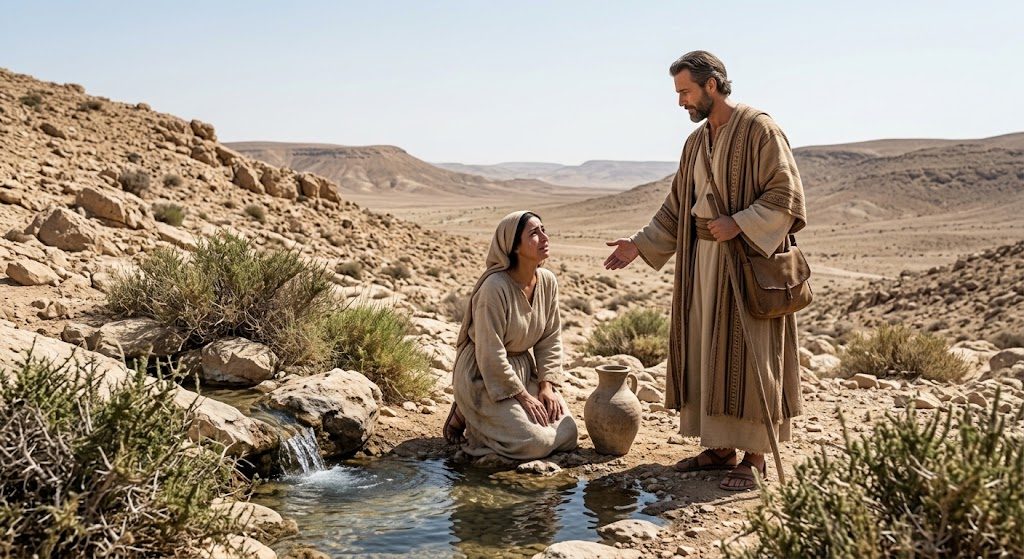
Today’s Passage: Genesis 16:1-13
Ten years have passed since God promised Abram a son. Sarai and Abram are still waiting. Sarai engineers her own solution, and her plan crushes a servant named Hagar. This chapter follows Hagar into the desert, where she meets God face to face and discovers a profound reality. God sees the one no one else is watching.
Context A servant without a defender
Hagar belongs to Sarai as property. Under the cultural laws of the ancient Near East, a servant possesses no rights to self-defense. Hagar has no husband to intercede for her and no family to demand justice. She exists entirely at the mercy of her owners.
Genesis 16:1-2 (BSB)
¹ Now Abram’s wife Sarai had borne him no children, but she had an Egyptian maidservant named Hagar. ² So Sarai said to Abram, “Look now, the LORD has prevented me from bearing children. Please go to my maidservant; perhaps I can build a family by her.” And Abram listened to the voice of Sarai.
Sarai leverages Hagar as an instrument to build a family. Abram accepts the proposal immediately. They treat Hagar strictly as a utility.
Genesis 16:3-4 (BSB)
³ So after he had lived in Canaan for ten years, his wife Sarai took her Egyptian maidservant Hagar and gave her to Abram to be his wife. ⁴ And he slept with Hagar, and she conceived. But when Hagar realized that she was pregnant, she began to despise her mistress.
Hagar possesses no authority to refuse this arrangement. Once she conceives, she begins to view her mistress with contempt. Bitterness takes root in both women. Sarai faces the shame of barrenness, and Hagar faces the reality of forced surrogacy.
Genesis 16:5-6 (BSB)
⁵ Then Sarai said to Abram, “May the wrong done to me be upon you! I delivered my servant into your arms, and ever since she saw that she was pregnant, she has treated me with contempt. May the LORD judge between you and me.” ⁶ “Here,” said Abram, “your servant is in your hands. Do whatever you want with her.” Then Sarai treated Hagar so harshly that she fled from her.
Sarai shifts the blame to Abram for the exact plan she initiated. Abram abdicates his responsibility and hands Hagar back over to Sarai’s abuse. Scripture records the failure of these patriarchs with complete historical honesty. They drive a pregnant woman out into the wilderness.
Genesis 16:7-8 (BSB)
⁷ Now the angel of the LORD found Hagar by a spring of water in the desert—the spring along the road to Shur. ⁸ “Hagar, servant of Sarai,” he said, “where have you come from, and where are you going?” “I am running away from my mistress Sarai,” she replied.
Hagar flees into the hostile environment of the desert. God intercepts her at a spring of water. He addresses her by her actual name and title. He demands an account of her journey.
Genesis 16:9-10 (BSB)
⁹ So the angel of the LORD told her, “Return to your mistress and submit to her authority.” ¹⁰ Then the angel added, “I will greatly multiply your offspring so that they will be too numerous to count.”
God issues a difficult command for Hagar to return and submit to Sarai. He immediately follows this command with a massive covenant promise. He guarantees her offspring will multiply beyond calculation. God secures a future for the child she carries.
Genesis 16:11-12 (BSB)
¹¹ The angel of the LORD proceeded: “Behold, you have conceived and will bear a son. And you shall name him Ishmael, for the LORD has heard your cry of affliction. ¹² He will be a wild donkey of a man, and his hand will be against everyone, and everyone’s hand against him; he will live in hostility toward all his brothers.”
God names the unborn child Ishmael. The name translates to “God hears.” God registers Hagar’s affliction long before she speaks to Him. He hears her cry in the desert, and then He makes sure she knows she is ra'ah, pronounced raw-AH. Strong's H7200, to see, look at, perceive. Hagar becomes the first person in the biblical record to give God a name. She stands alone in a barren wasteland as a fugitive. At the exact moment she feels entirely abandoned by humanity, she encounters the absolute certainty of God’s attention. by her Creator.
Genesis 16:13 (BSB)
¹³ So Hagar gave this name to the LORD who had spoken to her: “You are the God who sees me,” for she said, “Here I have seen the One who sees me!”
Study notes The God who searches and knows
Hagar experiences this divine attention at a specific spring in a specific desert. God demonstrates this same character throughout history.
"O LORD, You have searched me and known me. You know when I sit and when I rise; You understand my thoughts from afar. You search out my path and my lying down; You are aware of all my ways." Psalm 139:1-3 (BSB)
David records these words centuries after Hagar’s encounter. David lives a completely different life as a king, yet he identifies the exact same reality. God searches the individual, knows the individual, and tracks every step the individual takes.
Hagar’s story documents a profound truth about the character of God. God actively pursues the person the rest of the world ignores. You have an opportunity to reflect that character today. Reach out to one person in your life who feels forgotten. Send a text, make a phone call, or sit down with them for a few minutes. Give them the concrete evidence that someone sees them.
Pray to Close
Go to God and thank Him for His constant attention to the details of your life. Ask Him to show you the people around you who feel invisible or abandoned right now. Bring one specific forgotten person before Him, and pray for God to meet them exactly where they are today.
Worship for Today
He Knows My Name · Tommy Walker
This song vocalizes the reality Hagar discovered in the desert. God tracks the small details of a human life, and He continually pays attention. The lyrics provide a simple truth you can sing today.
Listen: