Today’s Passage: Acts 2:14–41
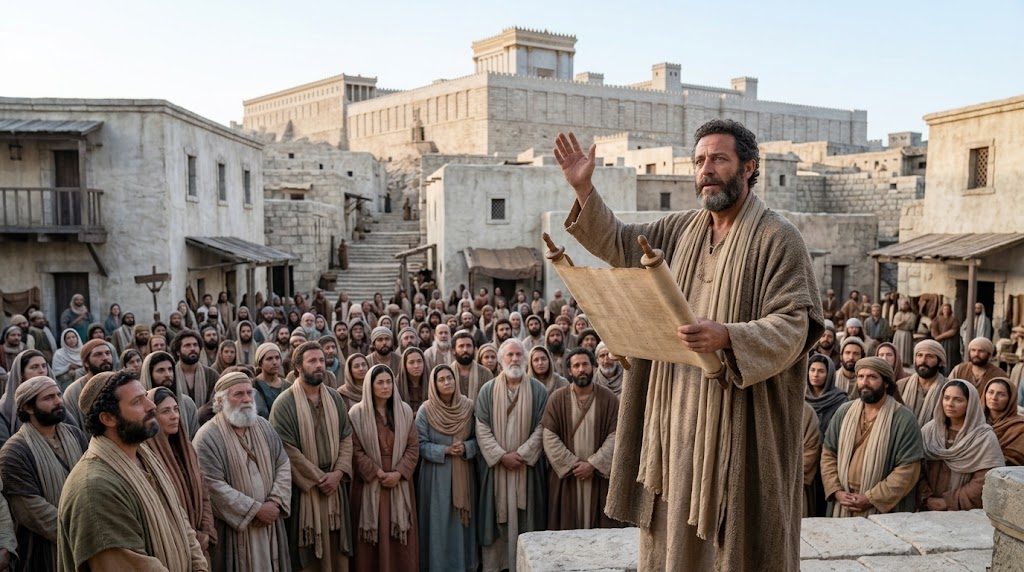
Yesterday Luke left a whole city asking what the wind and the fire meant. Today Peter answers them. He stands up in the street and begins to preach. Examine the evidence he presents, and observe what he leaves out. The sermon was the actual point. The sign was never the focus.
Context The audience in the street
Yesterday’s text listed the origins of the travelers. These men were Jews and converts to Judaism gathered in Jerusalem for the festival. They knew the Old Testament text. Peter can quote a dead prophet and expect the crowd to follow his argument because they already recognized the authority of the Scriptures.
Acts 2:14–16 (BSB)
¹⁴ Then Peter stood up with the Eleven, lifted up his voice, and addressed the crowd: “Men of Judea and all who dwell in Jerusalem, let this be known to you, and listen carefully to my words. ¹⁵ These men are not drunk, as you suppose. It is only the third hour of the day! ¹⁶ No, this is what was spoken by the prophet Joel:
Peter dismisses the accusation of drunkenness with a single historical fact: it is only nine in the morning. Then he builds his case. He grounds his entire argument in the written text, passing over the fire and the wind without explanation. The prophet Joel had been dead for centuries, yet Peter opens his book to establish the facts.
Acts 2:17 (BSB)
¹⁷ ‘In the last days, God says, I will pour out My Spirit on all people. Your sons and daughters will prophesy, your young men will see visions, your old men will dream dreams.
Peter reaches across hundreds of years and reads Joel aloud. Pay attention to the claim: I will pour out My Spirit. God promised this event long before it happened. Look closely at verse 16. Peter states, this is what Joel spoke of. He identifies the current event as the direct fulfillment of biblical prophecy. His foundation is the written word of God. From that firm ground, he moves directly to the person of Jesus.
Acts 2:22–24 (BSB)
²² Men of Israel, listen to this message: Jesus of Nazareth was a man certified by God to you by miracles, wonders, and signs, which God did among you through Him, as you yourselves know. ²³ He was delivered up by God’s set plan and foreknowledge, and you, by the hands of the lawless, put Him to death by nailing Him to the cross. ²⁴ But God raised Him from the dead, releasing Him from the agony of death, because it was impossible for death to keep Him in its grip.
Here is the core of the sermon. Verse 22 establishes Jesus of Nazareth as a man certified by God. The miracles and wonders authenticated Him. They proved His identity so you would listen to His message. Verse 23 presents the stark facts. Lawless men drove the nails, yet the crucifixion unfolded according to God’s deliberate plan. Then Peter delivers the verdict in verse 24. God raised Jesus from the dead. Death lacked the power to hold Him.
Acts 2:33 (BSB)
³³ Exalted, then, to the right hand of God, He has received from the Father the promised Holy Spirit and has poured out what you now see and hear.
The wind, the fire, and the dialektos, pronounced dee-AL-ek-toss. Strong's G1258, a language, one's own native tongue or dialect. This word identifies the language a person speaks at home every day. Our English word dialect derives from it. God delivered His message that morning in the specific languages the listeners already knew, ensuring they could examine the evidence and understand the truth. all originated with Jesus. Each element serves as evidence pointing back to Him.
Acts 2:36 (BSB)
³⁶ Therefore let all Israel know with certainty that God has made this Jesus, whom you crucified, both Lord and Christ!”
The title Christ means Anointed One. Peter concludes his case here. He rests his argument entirely on the historical identity and supreme authority of Jesus.
Study notes The mission of the Spirit
Jesus informed His disciples in advance about the Spirit’s work.
"He will glorify Me by taking from what is Mine and disclosing it to you." John 16:14 (BSB)
The Spirit points to Jesus. He does not draw attention to Himself. That is exactly what happens in Acts 2. The tongues and the events of that morning were real historical facts, yet the Spirit came to ensure Jesus was preached. God has recorded what He wants you to know about His Son in an objective, historical book you can hold in your hands. You have the complete record and do not need to wait for additional revelations.
Acts 2:37–38 (BSB)
³⁷ When the people heard this, they were cut to the heart and asked Peter and the other apostles, “Brothers, what shall we do?” ³⁸ Peter replied, “Repent and be baptized, every one of you, in the name of Jesus Christ for the forgiveness of your sins, and you will receive the gift of the Holy Spirit.
Confronted with the evidence, the crowd asks a practical question: “What shall we do?” Peter gives a direct command. He tells them to repent and be baptized. He offers no instructions for replicating the wind or the fire. The invitation was Jesus Himself. The signs were merely the setup.
Acts 2:41 (BSB)
⁴¹ Those who embraced his message were baptized, and about three thousand were added to the believers that day.
Three thousand people responded to the evidence in a single morning. A man who read the Old Testament aloud and presented the historical facts about Jesus convinced them. The wind and the fire served only to gather the crowd. You can apply this same reliance on Scripture today. Identify one specific truth you believe about God, locate the verse in your Bible, and read it out loud to cement the fact in your mind.
Pray to Close
Go to God in prayer and acknowledge Jesus as the appointed Lord and Christ. Thank God for providing a reliable, written record of the truth so you can know exactly who Jesus is. Ask the Holy Spirit to open your eyes to the evidence in Scripture, making the reality of Jesus larger and clearer to you today.
Worship for Today
Christ Be Magnified · Cody Carnes
This song mirrors Peter’s sermon by focusing entirely on Jesus. Listen to it as you finish your study today, letting the facts of who Christ is anchor your mind.
Listen: