Today’s Passage: Luke 3:21–22; 4:14–21
For two days we have examined the Spirit of God at work. Today we see Him come to rest on one Man. Luke presents two historical scenes: Jesus praying at a river, and Jesus reading aloud in His hometown. Review the evidence, because it establishes a profound fact. Even Jesus worked in the Spirit’s power.
Luke 3:21 (BSB)
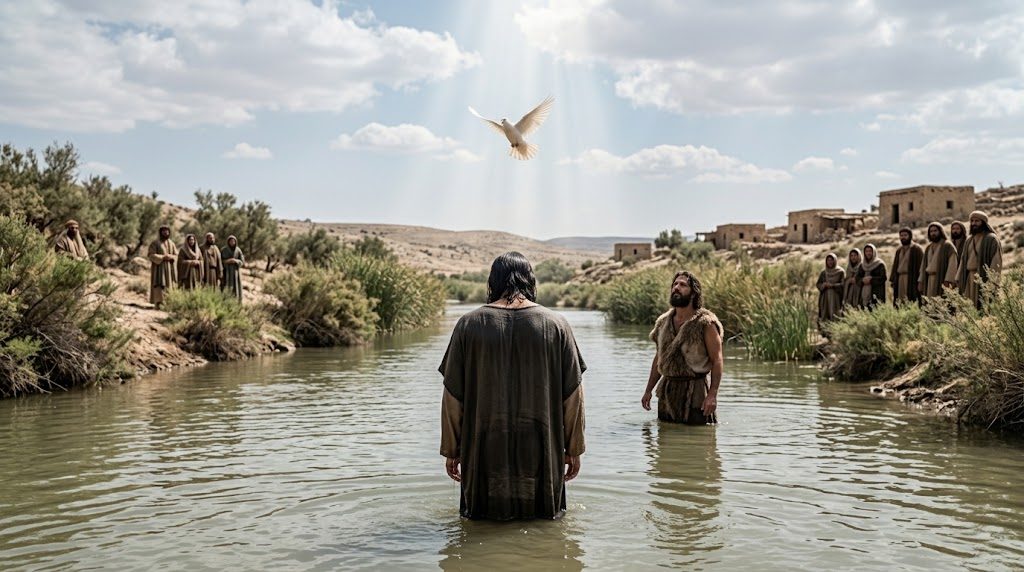
²¹ When all the people were being baptized, Jesus was baptized too. And as He was praying, heaven was opened,
Crowds of people stood at the river, and Jesus steps into the line with them. He possessed no sin to confess. He entered the water anyway. Observe what He was doing when heaven opened above Him. He was praying.
Luke 3:22 (BSB)
²² and the Holy Spirit descended on Him in a bodily form like a dove. And a voice came from heaven: “You are My beloved Son; in You I am well pleased.”
Look at the evidence in this single verse. The Son stands in the water. The Spirit comes down to rest on Him. The Father speaks from heaven. All three persons of the Trinity are present in one historical moment. Examine the Father’s words. He says, “You are My beloved Son.” Jesus existed as the Son from all eternity. The voice from heaven declares a fact. It does not create the fact. Jesus was already fully God as He stood in the Jordan River. What begins on this day is His public work.
Luke 4:14–15 (BSB)
¹⁴ Jesus returned to Galilee in the power of the Spirit, and the news about Him spread throughout the surrounding region. ¹⁵ He taught in their synagogues and was glorified by everyone.
Luke records the facts plainly. Jesus returned to Galilee in the power of the Spirit. Luke writes this detail about Jesus Himself. Mark that phrase in your mind.
Context What a reading in Nazareth looked like
Nazareth was a small town. The people in that room had watched Jesus grow up. In those days, Scripture was kept on scrolls, and synagogues followed a strict procedure for reading them. Standing up to read declared, “These are God’s own words.” Sitting down afterward signaled, “Now I will teach you what they mean.”
Luke 4:16–17 (BSB)
¹⁶ Then Jesus came to Nazareth, where He had been brought up. As was His custom, He entered the synagogue on the Sabbath. And when He stood up to read, ¹⁷ the scroll of the prophet Isaiah was handed to Him. Unrolling it, He found the place where it was written:
Jesus attended the synagogue every week. It was His custom. Notice that He found the place in the scroll Himself. Nobody chose the text for Him.
Luke 4:18–19 (BSB)
¹⁸ “The Spirit of the Lord is on Me, because He has anointed Me to preach good news to the poor. He has sent Me to proclaim liberty to the captives and recovery of sight to the blind, to release the oppressed, ¹⁹ to proclaim the year of the Lord’s favor.”
Jesus could have selected any passage in the scrolls. He chose these specific words to read aloud about Himself. His very first claim is that the Spirit of the Lord is on Him. Look at the people Isaiah lists: the poor, the prisoners, the blind, and the oppressed. The chriō, pronounced KHREE-oh. Strong's G5548, to anoint, pour oil on, set apart for office. To anoint someone was to pour oil on them. Israel used this action to mark out a king or a priest for his official work. The English word Christ translates this Greek verb. It is a title, meaning the Anointed One. Jesus was anointed with the Spirit of the Lord Himself for His earthly mission. One comes specifically to them.
Luke 4:20–21 (BSB)
²⁰ Then He rolled up the scroll, returned it to the attendant, and sat down. The eyes of everyone in the synagogue were fixed on Him, ²¹ and He began by saying, “Today this Scripture is fulfilled in your hearing.”
He rolled up the scroll, handed it back, and sat down. Every eye in the room fixed on Him. He spoke one sentence, beginning with a single word: Today. Isaiah wrote those words centuries earlier. Jesus now tells His hometown that the long wait is over.
Study notes The words Jesus was reading
Here is Isaiah’s original text, recorded centuries before that morning.
"The Spirit of the Lord GOD is on Me, because the LORD has anointed Me to preach good news to the poor. He has sent Me to bind up the brokenhearted, to proclaim liberty to the captives and freedom to the prisoners," Isaiah 61:1 (BSB)
Isaiah names the Spirit before he names the good news. God’s Anointed One would always be the Spirit-filled One. Jesus tells the room plainly that He is the man Isaiah wrote about.
Jesus is fully God. That fact did not change at the river. Yet Luke documents exactly how the Son carried out His work on earth. He operated in the power of the Spirit from the first day to the last. You have access to that exact same power. Before you face the first difficult task in your schedule today, stop and state the facts out loud: “God’s Spirit is in me. I am not doing this alone.”
Pray to Close
Begin your prayer by praising God that Jesus willingly stepped into the water beside ordinary people for your sake. Ask Him to give you the willingness to work in His strength today. Thank Him that the exact same Spirit who empowered Jesus for His earthly ministry now lives inside you.
Worship for Today
Jesus Messiah · Chris Tomlin
The title Christ means the Anointed One. It designates the man on whom the Spirit rests. This song takes that historic title and directs it straight back to Him as worship. Listen and sing along.
Listen: