Today’s Passage: John 10:22–39
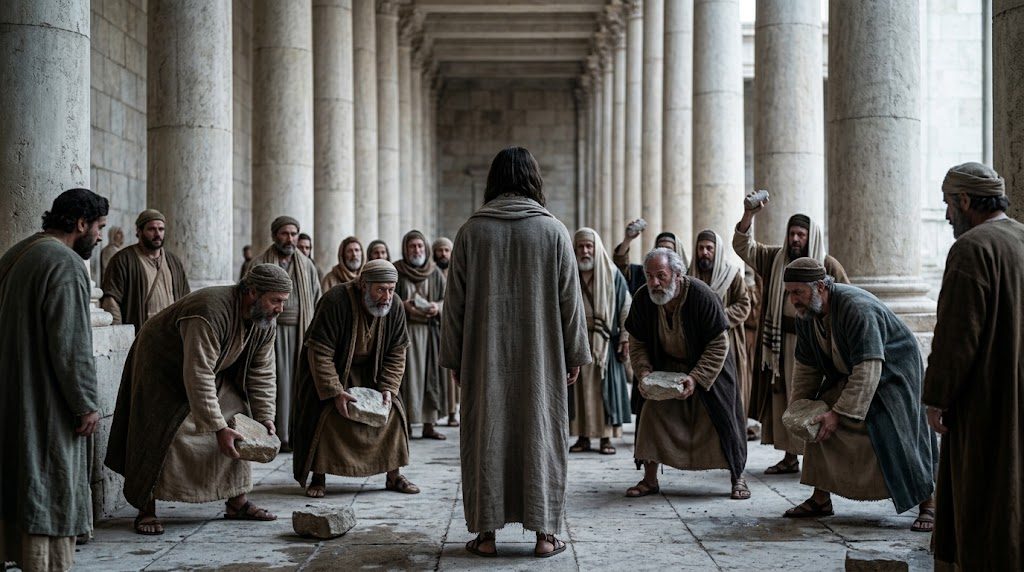
Winter winds sweep through Jerusalem, and Jesus walks the temple courts during the Feast of Dedication. This holiday marks the historical moment the Jewish people recaptured their temple from a foreign dictator. A hostile crowd surrounds Jesus with a blunt demand: tell us plainly if you are the Christ. Jesus answers with the evidence of His miracles, followed by a staggering claim. Accused of claiming to be God, Jesus stands His ground. He defends His identity.
Context The Feast of Dedication
The Feast of Dedication is Hanukkah. A century and a half earlier, a foreign king desecrated the temple. The Jewish people recaptured the grounds and rededicated them to God. Solomon’s Colonnade offers a covered stone walkway against the winter chill. The interrogators demand a straight answer. Jesus provides one.
John 10:22–30 (BSB)
²² At that time the Feast of Dedication took place in Jerusalem. It was winter, ²³ and Jesus was walking in the temple courts in Solomon’s Colonnade. ²⁴ So the Jews gathered around Him and demanded, “How long will You keep us in suspense? If You are the Christ, tell us plainly.” ²⁵ “I already told you,” Jesus replied, “but you did not believe. The works I do in My Father’s name testify on My behalf. ²⁶ But because you are not My sheep, you refuse to believe. ²⁷ My sheep listen to My voice; I know them, and they follow Me. ²⁸ I give them eternal life, and they will never perish. No one can snatch them out of My hand. ²⁹ My Father who has given them to Me is greater than all. No one can snatch them out of My Father’s hand. ³⁰ I and the Father are one.”
They demand a plain answer, and Jesus gives them hard evidence. He points out His miracles. He points out His followers—the sheep He holds so securely that no thief can pry them from His grip. Then He issues the verdict: I and the Father are hen, pronounced hen. Strong's G1520, one, a single unified thing. Jesus states they share the exact same essence. He claims absolute unity as one God. . Using the plainest vocabulary available, Jesus states that He shares the nature of God.
John 10:31–33 (BSB)
³¹ At this, the Jews again picked up stones to stone Him. ³² But Jesus responded, “I have shown you many good works from the Father. For which of these do you stone Me?” ³³ “We are not stoning You for any good work,” said the Jews, “but for blasphemy, because You, who are a man, make Yourself out to be God.”
Look closely at the crowd’s reaction. They understand His words perfectly. They stoop to grab loose paving stones to crush Him. They shout their exact charge: blasphemy. Under their law, a mere man claiming to be God commits a capital crime. Jesus speaks without riddles. He declares Himself God.
John 10:34–39 (BSB)
³⁴ Jesus replied, “Is it not written in your Law: ‘I have said you are gods’? ³⁵ If he called them gods to whom the word of God came—and the Scripture cannot be broken— ³⁶ then what about the One whom the Father sanctified and sent into the world? How then can you accuse Me of blasphemy for stating that I am the Son of God? ³⁷ If I am not doing the works of My Father, then do not believe Me. ³⁸ But if I am doing them, even though you do not believe Me, believe the works themselves, so that you may know and understand that the Father is in Me, and I am in the Father.” ³⁹ At this, they tried again to seize Him, but He escaped their grasp.
Jesus builds His defense directly from their own Scriptures. In Psalm 82, God refers to human judges as “gods” because they exercise divine authority on earth. Jesus argues from the lesser to the greater. If Scripture applies that title to mortal judges, how can you charge the actual Son of God with blasphemy? He submits His miracles as exhibit A. He challenges them to examine the evidence of His works, even if they reject His words. The crowd lunges for Him. Jesus walks away. His hour remains in the future.
Study notes He stands by His words
Jesus accepts their premise. He stares down a mob holding rocks, repeats His claim, and holds His ground. He refuses to retract a single syllable.
"The Son is the radiance of God’s glory and the exact representation of His nature, upholding all things by His powerful word. After He had provided purification for sins, He sat down at the right hand of the Majesty on high." Hebrews 1:3 (BSB)
Examine the record yourself. Accused of claiming to be God, Jesus defends His identity with evidence. You must decide what to do with a man who makes this claim and backs it up with verifiable miracles. Weigh the evidence today, and act on your verdict. Speak one true sentence about who Jesus is out loud to someone you encounter.
Pray to Close
Thank God that Jesus spoke the truth about His identity and stood firm under pressure. Ask Him for the courage to examine the evidence and take Jesus at His word. Confess any moments you have stayed quiet about who Christ really is. Ask for the boldness to share the truth with others.
Worship for Today
Song: This I Believe (The Creed), by Hillsong Worship
This song sets the historic Christian confession to music. It declares that Jesus is fully God and fully man. The lyrics stand on the very claim Jesus defends in today’s passage. Sing it as your own verdict.
Listen: