Today’s Passage: John 8:48–59
Jesus teaches in the Jerusalem temple. The religious leaders stand furious before Him. The argument turns personal. Jesus makes the boldest claim in the entire Bible. He claims God’s own name, and everyone in the room knows exactly what He means.
Context A fight in the temple
The tension in the courtyard built all day. Jesus told the crowd the truth would set them free (John 8:32). The religious authorities—identified in the text as “the Jews”—pushed back. They claimed Abraham as their father. Jesus countered that their actions proved otherwise. Today’s passage drops you into the middle of this fierce exchange.
John 8:48–51 (BSB)
⁴⁸ The Jews answered Him, “Are we not right to say that You are a Samaritan and You have a demon?” ⁴⁹ “I do not have a demon,” Jesus replied, “but I honor My Father, and you dishonor Me. ⁵⁰ I do not seek My own glory. There is One who seeks it, and He is the Judge. ⁵¹ Truly, truly, I tell you, if anyone keeps My word, he will never see death.”
The leaders lack a logical answer, so they hurl insults. Jesus ignores the insults and points directly to His Father, the Judge who seeks His glory. Then He delivers a staggering promise. Anyone who keeps His word will never see death. He speaks of eternal life, promising an absolute rescue from the grave.
John 8:52–56 (BSB)
⁵² “Now we know that You have a demon!” declared the Jews. “Abraham died, and so did the prophets, yet You say that anyone who keeps Your word will never taste death. ⁵³ Are You greater than our father Abraham? He died, as did the prophets. Who do You claim to be?” ⁵⁴ Jesus answered, “If I glorify Myself, My glory means nothing. The One who glorifies Me is My Father, of whom you say, ‘He is our God.’ ⁵⁵ You do not know Him, but I know Him. If I said I did not know Him, I would be a liar like you. But I do know Him, and I keep His word. ⁵⁶ Your father Abraham rejoiced that he would see My day. He saw it and was glad.”
The promise sounds impossible to these men. They know the historical facts. Abraham died. The prophets died. They demand an answer to the ultimate question: Who do You claim to be? Jesus answers by reaching across the centuries. He states that Abraham himself looked forward to this exact day. Abraham anticipated the arrival of the Messiah.
John 8:57–59 (BSB)
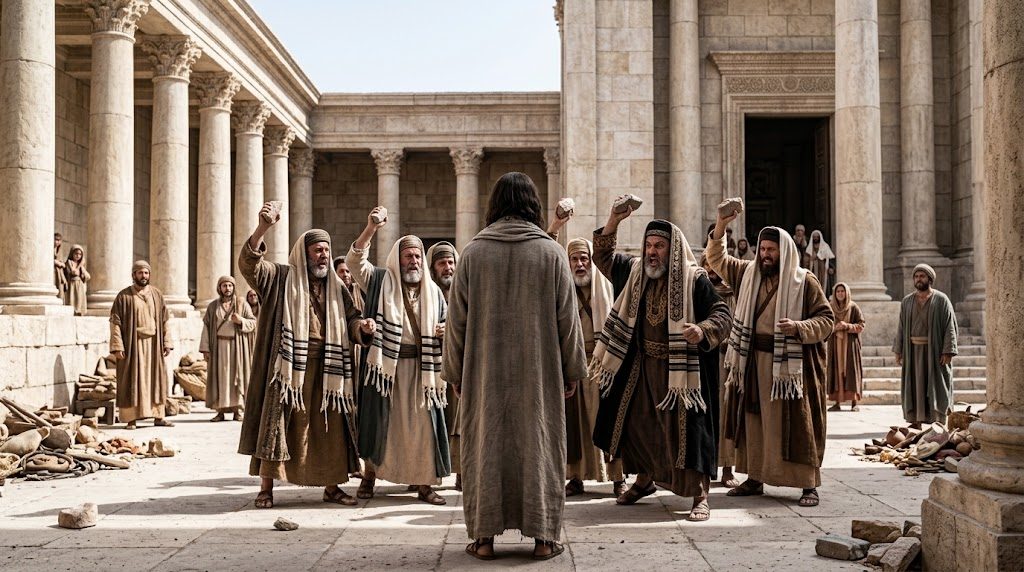
⁵⁷ Then the Jews said to Him, “You are not yet fifty years old, and You have seen Abraham?” ⁵⁸ “Truly, truly, I tell you,” Jesus declared, “before Abraham was born, I am!” ⁵⁹ At this, they picked up stones to throw at Him. But Jesus was hidden and went out of the temple area.
Word study "I am": *egō eimi* (John 8:58)
Greek: ἐγὼ εἰμί (egō eimi), pronounced eh-GO ay-MEE. Strong’s G1473 + G1510.
The phrase translates to “I am.” God spoke these exact words at the burning bush when He gave Moses His personal name (Exodus 3:14). Jesus speaks in the present tense of eternal existence. He says, “I am.” He takes the eternal name of God and applies it to Himself.
The leaders calculate the math. Jesus stands before them at less than fifty years old. They challenge His timeline. Jesus responds with a statement of eternal existence. He says, before Abraham was born, I am. The men in that courtyard grasp the implications immediately. You see the evidence in their reaction. They reach for the heavy limestone paving stones. Jewish law demands stoning for a mere man who claims to be God. Jesus forces a verdict. He is either a blasphemer worthy of death, or He is exactly who He claims to be. His appointed hour remains in the future. He walks out of the temple untouched.
Study notes The name at the burning bush
Centuries before this confrontation in the temple, Moses stood before a burning bush and asked God for His name. God provided an answer that became the most sacred name in Scripture.
"God said to Moses, “I AM WHO I AM. This is what you are to say to the Israelites: ‘I AM has sent me to you.’”" Exodus 3:14 (BSB)
When Jesus speaks the words “I am” in the temple courtyard, He reaches back to the burning bush. He claims the divine identity.
Jesus claims God’s own name. Everyone in the room knows exactly what He means. The evidence demands a decision from you, just as it did from the men holding the stones. Today, speak out loud one true thing you believe about the identity of Jesus. State the facts of who He is, and let that reality anchor your faith.
Pray to Close
Go to God in prayer and acknowledge Jesus as the eternal I AM. Thank Him for declaring His identity clearly, even when it placed His life in danger. Ask God for the faith to accept the staggering claims Jesus made about Himself. Confess any lingering doubts you hold, and ask Him to anchor your mind in the truth of who He is.
Worship for Today
Yahweh, Great I Am · Hillsong Worship
This song takes the name God gave Moses at the burning bush and directs it to Jesus. Sing it as your verdict, embracing the claim the crowd met with stones.
Listen: