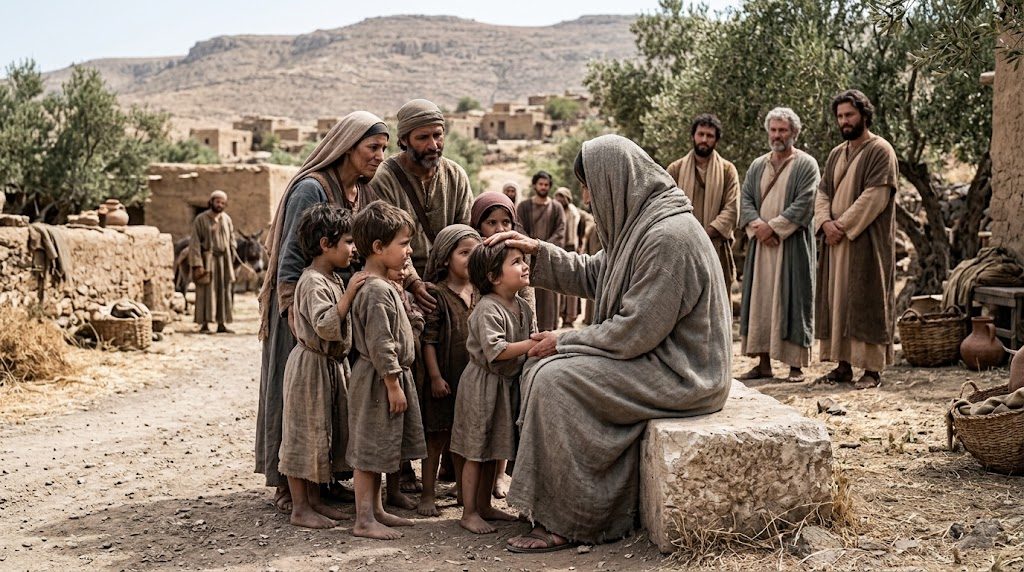
Today’s Passage: Mark 10:13–16
Parents bring their children to Jesus for a blessing. The disciples turn them away. The resulting scene gives us a clear look at the character of Christ. He responds with evident anger toward His followers and profound gentleness toward the children. This historical event establishes a fundamental truth about following Him. The kingdom of God cannot be earned. It is received like a child.
Context The Status of Children
First-century culture assigned no social standing to a child. Children possessed no money, held no authority, and offered no advantage to a public figure. The disciples view these parents as an interruption to a busy rabbi’s schedule. Jesus reverses this cultural standard. He demonstrates that people bringing absolutely nothing to the table are the exact model for entering His kingdom.
Mark 10:13–14 (BSB)
¹³ Now people were bringing the little children to Jesus for Him to place His hands on them, and the disciples rebuked those who brought them. ¹⁴ But when Jesus saw this, He was indignant and told them, “Let the little children come to Me, and do not hinder them! For the kingdom of God belongs to such as these.
The disciples assume they are managing the Master’s itinerary. They apply the cultural logic of their day. Jesus responds with indignation. The Greek term indicates open, visible anger. The Gospel records rarely show Jesus reacting this way. He expresses this anger to defend the least influential people in the crowd. He issues a direct command to let them approach. He then states the central fact. The kingdom of God belongs entirely to people like these children.
Mark 10:15–16 (BSB)
¹⁵ Truly I tell you, anyone who does not receive the kingdom of God like a little child will never enter it.” ¹⁶ And He took the children in His arms, placed His hands on them, and blessed them.
Jesus uses His most solemn introductory phrase, truly I tell you. He establishes a requirement for every person. You must approach God by having the kingdom dechomai, pronounced DEH-khoh-my. Strong's G1209, to receive, take what is handed to you. This specific Greek word means accepting an object handed directly to you. Jesus requires you to open your hands and take what He offers. A child accepts a present with open hands and zero intention of paying the giver back. . You take it exactly as a child accepts a gift.
A child ignores the price tag on a gift. An adult often insists on paying his own way. The individual attempting to purchase salvation repeatedly fails because the kingdom of God remains a pure gift. Mark records the historical outcome. Jesus gathers the children into His arms and blesses them. He welcomes empty hands. Take time today to thank God out loud for a specific gift you could never earn. Acknowledge your reliance on Him and accept His grace with the simple, open hands of a child.
Study notes The Requirement of Childlikeness
Jesus assigns the kingdom to children based on their posture of dependence. Children possess an inherent understanding of how to receive. Jesus repeats this absolute condition in another account.
"Truly I tell you," He said, "unless you change and become like little children, you will never enter the kingdom of heaven." Matthew 18:3 (BSB)
Pray to Close
Thank God for offering the kingdom as a pure gift and for never being too busy to welcome you. Ask Him to help you approach Him today with the open, unashamed hands of a child. Confess any pride that drives you to try paying your own way, and rest in His willingness to hold you close.
Worship for Today
Jesus Loves Me · Anna B. Warner & William Bradbury
This historic hymn communicates profound theological truth in simple language. After decades of academic research, scholars continually return to this core reality. Sing it as an expression of faith today. Allow the youngest voice in the room to set the pace.
Listen: