Today’s Passage: Jonah 4
Nineveh turned. God relented. Jonah is furious. He wanted a verdict of destruction. He witnessed a pardon. God questions him about a plant. Then He asks about a city. The last words of the book present the core issue. You pitied a plant. Should I not pity a city?
Context East of the city
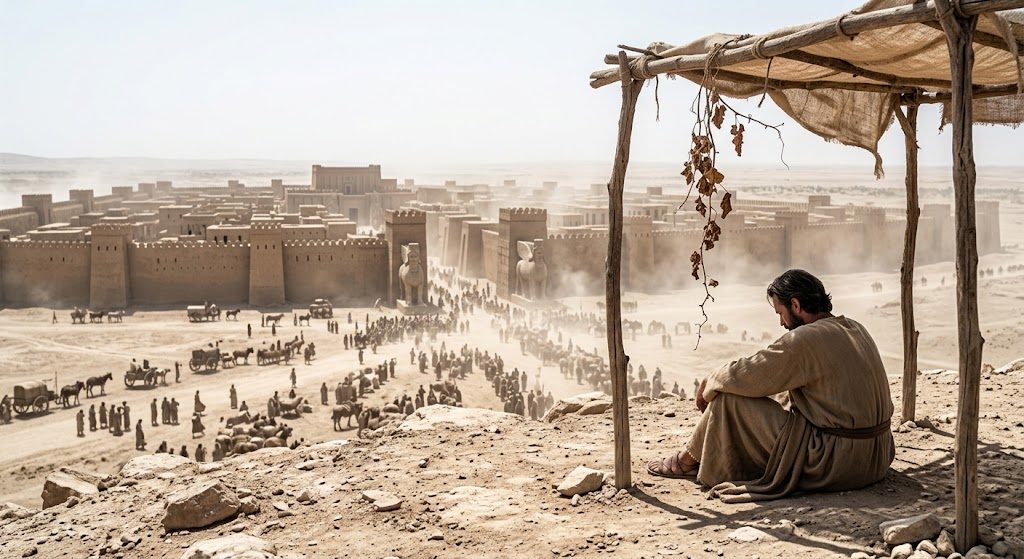
Jonah marches out of Nineveh and sits on the east side. He builds a rough shelter. He waits to see if judgment will fall on the city. God acts. He appoints a plant for shade, a worm to destroy it, and a scorching wind to beat down on the prophet. God builds a case on that hillside. The verdict He demands is pity.
Jonah 4:1–4 (BSB)
¹ Jonah, however, was greatly displeased, and he became angry. ² So he prayed to the LORD, saying, “O LORD, is this not what I said while I was still in my own country? This is why I was so quick to flee toward Tarshish. I knew that You are a gracious and compassionate God, slow to anger, abounding in loving devotion—One who relents from sending disaster. ³ And now, O LORD, please take my life from me, for it is better for me to die than to live.” ⁴ But the LORD replied, “Have you any right to be angry?”
Jonah is angry because God is compassionate. People often disguise anger as holiness. Jonah states his resentment plainly. He quotes the historic creed of Israel as an accusation. He knows the facts about God. The LORD is gracious, compassionate, slow to anger, and abounding in loving devotion.
Jonah ran because he understood God perfectly. He knew God would forgive. He refused to extend that kindness to Nineveh. He demands his own death rather than watch Nineveh live. The LORD counters with a cross-examination. Have you any right to be angry?
Jonah 4:5–8 (BSB)
⁵ Then Jonah left the city and sat down east of it, where he made himself a shelter and sat in its shade to see what would happen to the city. ⁶ So the LORD God appointed a vine, and it grew up to provide shade over Jonah’s head to ease his discomfort, and Jonah was greatly pleased with the plant. ⁷ When dawn came the next day, God appointed a worm that attacked the plant so that it withered. ⁸ As the sun was rising, God appointed a scorching east wind, and the sun beat down on Jonah’s head so that he grew faint and wished to die, saying, “It is better for me to die than to live.”
Jonah leaves the city limits and sits on the east side. He builds a shelter and waits. He still expects the fire and brimstone he preached. The LORD God appoints a plant to grow over Jonah’s head to ease his physical discomfort. Jonah is thrilled with the plant. He despises the mercy God showed the city. He loves the shade.
The next day God appoints a worm. The worm attacks the plant. The plant withers. Then God appoints a scorching east wind. The sun beats down on Jonah’s head. He grows faint and asks to die. His comfort lasted a single night. His joy vanished with it.
Jonah 4:9–11 (BSB)
⁹ Then God asked Jonah, “Have you any right to be angry about the plant?” “I do,” he replied. “I am angry enough to die!” ¹⁰ But the LORD said, “You cared about the plant, which you neither tended nor made grow. It sprang up in a night and perished in a night. ¹¹ So should I not care about the great city of Nineveh, which has more than 120,000 people who cannot tell their right hand from their left, and many cattle as well?”
The English translation says “ ḥûs, pronounced KHOOS. Strong's H2347, to pity, look on with compassion, spare. This word means pity. Jonah felt pity for a plant he never cultivated or watered. God asks if He has the right to pity an entire city. This is the central argument of the text. .” The Hebrew word requires a closer look.
God presents the evidence. More than a hundred and twenty thousand people live in Nineveh. They cannot tell their right hand from their left. God counts the people. He counts the cattle. Jonah counted a single vine.
The book ends on a hanging question. Jonah remains silent. You must sit with the question. The plant was a temporary, physical comfort. The city represents eternal mercy. God stands firm in His mercy.
Study notes The confession he used against God
Jonah built his complaint on Israel’s greatest treasure. God revealed His own character to Moses with these exact words.
"The LORD, the LORD God, is compassionate and gracious, slow to anger, abounding in loving devotion and faithfulness." Exodus 34:6 (BSB)
Jonah knew the facts. He hated the application of those facts in Nineveh. God remains the God of Exodus 34. He holds pity for a city. You can praise Him for His unchanging character, even when you want Him to show less kindness to your enemies.
The plant withered. The question remains. Should I not pity a city? You must answer it today. Identify one person whose forgiveness or blessing from God bothers you. Ask God to give you His exact pity for them. Name them in your prayer. State the facts clearly, and ask Him to change your heart.
Pray to Close
Talk to God about His profound compassion. Thank Him for showing mercy to people you might naturally condemn. Confess the specific times you have resented His kindness toward others. Ask Him to break your attachment to small comforts and replace it with His genuine pity for the lost.
Worship for Today
Hosanna · Hillsong United
God told Jonah to pity a city. This song asks God to break your heart for what breaks His. Sing it as a declaration of praise. Use the bridge to answer the final question in the book of Jonah.
Listen: