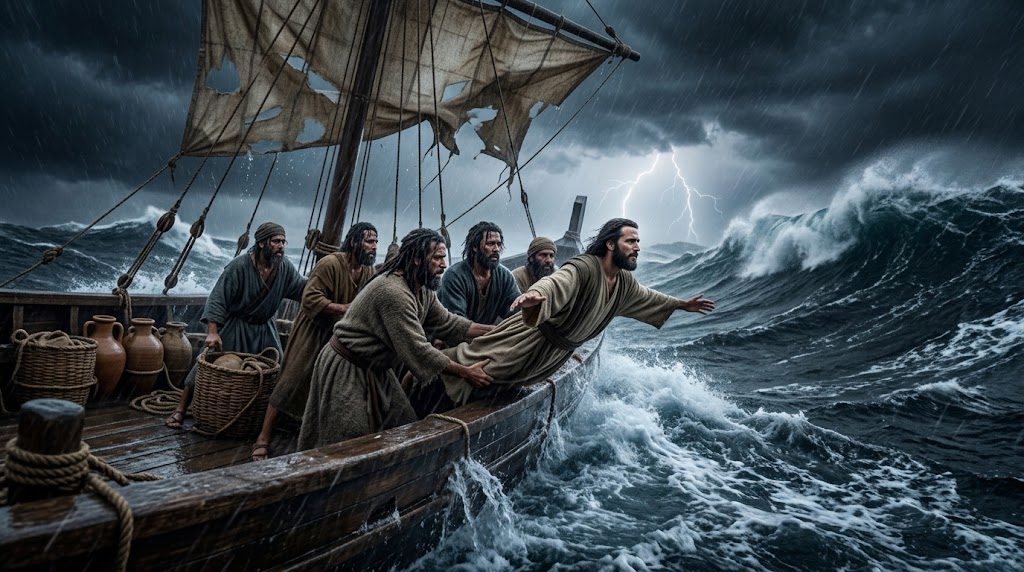
Today’s Passage: Jonah 1:4–16
Jonah boards a ship headed west. He buys a ticket to escape the word of God. Then the LORD throws a violent wind upon the sea. The storm is mercy, not spite. God uses the weather to stop a running man.
Context A ship, a lot, and a sleeping prophet
Ancient Mediterranean merchant vessels carried cargo and mixed crews. When severe weather hit, sailors prayed to their local deities and threw freight overboard to save the hull. They also cast lots to identify the offender causing the divine anger. Jonah rests below deck. He sleeps while the pagan sailors work and pray.
Jonah 1:4–6 (BSB)
⁴ Then the LORD hurled a great wind upon the sea, and such a violent storm arose that the ship was in danger of breaking apart. ⁵ The sailors were afraid, and each cried out to his own god. And they threw the ship’s cargo into the sea to lighten the load. But Jonah had gone down to the lowest part of the vessel, where he lay down and fell into a deep sleep. ⁶ The captain approached him and said, “How can you sleep? Get up and call upon your God. Perhaps this God will consider us, so that we may not perish.”
Yesterday Jonah paid a fare to travel in the opposite direction. Today the LORD answers that ticket with a gale. God sends weather Jonah cannot ignore.
Word study "Hurled": *ṭûl* (Jonah 1:4)
Hebrew: הֵטִיל (hēṭîl, from ṭûl), pronounced hay-TEEL. Strong’s H2904. The LORD throws the wind the way a man throws a stone. The storm has a firm hand behind it. That hand acts in mercy. The same God who has a command for Jonah chooses to stop him. He prefers a violent storm over letting His prophet sail away in peace.
The sailors cast lots to find the guilty man, and the lot falls on Jonah. He tells them the facts. He says, “I am a Hebrew. I worship the LORD, the God of the heavens, who made the sea and the dry land.” He claims to worship the Creator while actively running from Him. The sailors see the contradiction. “What have you done?” they ask. A man who knows the Maker of the ocean attempts to hide from Him on a boat.
Jonah 1:7–10 (BSB)
⁷ “Come!” said the sailors to one another. “Let us cast lots to find out who is responsible for this calamity that is upon us.” So they cast lots, and the lot fell on Jonah. ⁸ “Tell us now,” they demanded, “who is to blame for this calamity that is upon us? What is your occupation, and where have you come from? What is your country, and who are your people?” ⁹ “I am a Hebrew,” replied Jonah. “I worship the LORD, the God of the heavens, who made the sea and the dry land.” ¹⁰ Then the men were even more afraid and said to him, “What have you done?” The men knew that he was fleeing from the presence of the LORD, because he had told them.
The sea grows worse. The sailors ask Jonah how to calm the water. Jonah knows the answer. “Pick me up,” he says, “and cast me into the sea.” He offers his life so the crew might survive. This marks an honest start. Jonah stops pretending the storm centers on the sailors. The pagan crew rows hard to save him anyway. Mercy already operates on the deck. Men who do not know the LORD strain to save a prophet who admits he caused their peril.
Jonah 1:11–13 (BSB)
¹¹ Now the sea was growing worse and worse, so they said to Jonah, “What must we do to you to calm this sea for us?” ¹² “Pick me up,” he answered, “and cast me into the sea, so it may quiet down for you. For I know that I am to blame for this violent storm that has come upon you.” ¹³ Nevertheless, the men rowed hard to get back to dry land, but they could not, for the sea was raging against them more and more.
The sailors cry out to the LORD. They throw Jonah overboard, and the sea grows perfectly calm. These men immediately fear the LORD, offer a sacrifice, and make vows. The storm achieves what Jonah’s ticket failed to secure. It stops his flight. It forces both Jonah and the sailors to face God. The wind operates as a severe mercy. God sends a tempest to halt a man running toward his own ruin.
Jonah 1:14–16 (BSB)
¹⁴ So they cried out to the LORD: “Please, O LORD, do not let us perish on account of this man’s life! Do not charge us with innocent blood! For You, O LORD, have done as You pleased.” ¹⁵ Then they picked up Jonah and cast him into the sea, and the raging sea grew calm. ¹⁶ Then the men feared the LORD greatly, and they offered a sacrifice to the LORD and made vows to Him.
Study notes He stills what He hurled
The psalmist records this exact pattern. Men cry out from a violent sea. The LORD delivers them. He calms the water.
"Then they cried out to the LORD in their trouble, and He brought them out of their distress. He calmed the storm to a whisper, and the waves of the sea were hushed." Psalm 107:28–29 (BSB)
The same hand that hurls the wind can hush it. We can praise Him for this active mercy. He commands the storm, and He stays near to command the calm.
Jonah goes overboard, the sea quiets, and the sailors meet the LORD. The storm completes its work of mercy. You face storms in your own life. Identify one hard circumstance you have treated as God working against you. Look at the evidence of His hand. Speak to Him today and say, “This obstacle may be Your mercy. I will stay present, and I will stop running from You in the middle of it.” Let the wind do its work.
Pray to Close
Pray to the God who hurls the wind and stills the waves. Thank Him for choosing to send a storm rather than letting you drift away into rebellion. Confess the times you have viewed His stopping hand as cruelty. Ask Him to use your current obstacles to place you squarely in front of His face again.
Worship for Today
Sovereign Over Us · Michael W. Smith
The LORD hurled the wind, then hushed the sea. This song names Him sovereign in the fire and the flood. Sing it as a statement of fact. The storm that stops you serves as His mercy, and He remains in absolute control.
Listen: