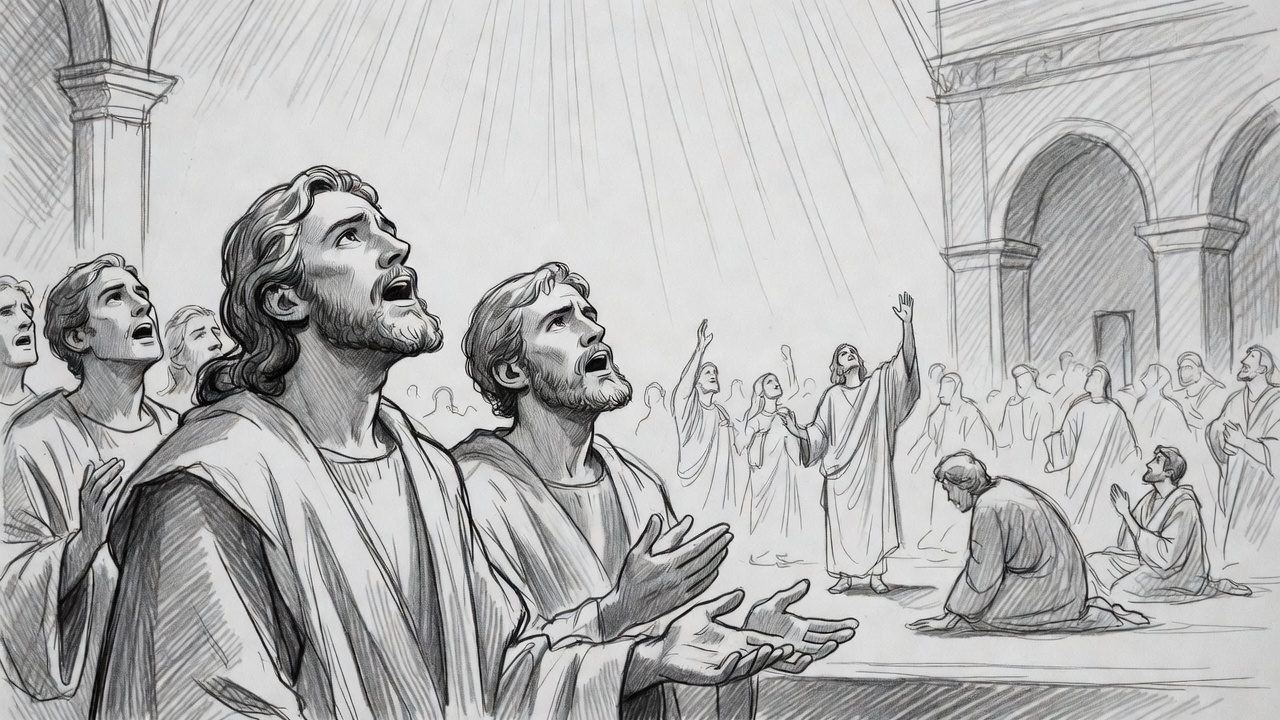
Today’s Passage: Acts 2:1–13
For four days we have followed the Holy Spirit through the Bible. Today the waiting ends. Read it slowly. Luke tells it like an eyewitness.
As you read, hold this: The promise God made in Ezekiel, He kept.
Context A city packed with visitors
Pentecost was a harvest festival held in Jerusalem every year. Pilgrims, meaning travelers who come a long way for a holy day, filled the city from all over the map. Many spoke a different language at home. That is why such a crowd was in the street that morning.
Acts 2:1 (BSB)
¹ When the day of Pentecost came, they were all together in one place.
A quiet sentence. Nothing has happened yet. “They” are the followers of Jesus. He told them to wait in Jerusalem, and they waited.
Acts 2:2 (BSB)
² Suddenly a sound like a mighty rushing wind came from heaven and filled the whole house where they were sitting.
Read that first word again. Suddenly. No warning at all.
Now notice what Luke writes. Not wind. A sound like wind. He is being careful. And notice where it comes from and where it goes: from heaven, into the house.
Word study "Rushing wind": pnoē (Acts 2:2)
Greek: πνοή (pnoē), pronounced pno-AY. Strong’s G4157.
The word means a blowing, a rushing wind, or a breath. It grows from the same root as pneuma, the Greek word for Spirit.
Go back now to the first day of this series. We held on to רוּחַ (ruach), Strong’s H7307, the Hebrew word for breath, wind, and Spirit. It was the word for the Spirit of God hovering over dark water in Genesis 1.
Here is the payoff. The breath that hovered over that dark water at the beginning of the world is the breath that filled a house in Jerusalem. Same Spirit. Same God. He has not changed since the second verse of the Bible.
Acts 2:3 (BSB)
³ They saw tongues like flames of fire that separated and came to rest on each of them.
Luke says like a second time. Not fire. Something that looked like it. Then watch where it goes. It comes to rest on each of them, one at a time.
Acts 2:4 (BSB)
⁴ And they were all filled with the Holy Spirit and began to speak in other tongues as the Spirit enabled them.
There is that word all again. Nobody was left out. And the end of the verse says who is doing it: as the Spirit enabled them. They did not work this up. It was given to them.
Acts 2:5–6 (BSB)
⁵ Now there were dwelling in Jerusalem God-fearing Jews from every nation under heaven. ⁶ And when this sound rang out, a crowd came together in bewilderment, because each one heard them speaking his own language.
The sound carries into the street, and the street comes running. Bewilderment means being so confused you cannot make sense of what you see. Then Luke tells us why. Each person was hearing his own language.
Acts 2:7–11 (BSB)
⁷ Astounded and amazed, they asked, “Are not all these who are speaking Galileans? ⁸ How is it then that each of us hears them in his own native language? ⁹ Parthians, Medes, and Elamites; residents of Mesopotamia, Judea and Cappadocia, Pontus and Asia, ¹⁰ Phrygia and Pamphylia, Egypt and the parts of Libya near Cyrene; visitors from Rome, ¹¹ both Jews and converts to Judaism; Cretans and Arabs—we hear them declaring the wonders of God in our own tongues!”
Galileans means people from Galilee, the country district up north where Jesus grew up. You could hear it the moment they opened their mouths.
Then comes the list. Luke could have written “people from everywhere.” He does not. He names them, region after region, and lets the roll call run long. Most of the known world was in that street, and each one heard about God in the language he learned as a child.
Acts 2:12–13 (BSB)
¹² Astounded and perplexed, they asked one another, “What does this mean?” ¹³ But others mocked them and said, “They are drunk on new wine!”
Two reactions, and Luke reports both without taking a side. Perplexed means completely puzzled. The honest ones admit it out loud, and their question is the best in the chapter.
The others take the easy way out and laugh. People still do that.
Study notes The promise, and the day it came true
Three days ago we read a promise God made through Ezekiel, and said we would carry it until we got here.
"And I will put My Spirit within you and cause you to walk in My statutes and to carefully observe My ordinances." Ezekiel 36:27 (BSB)
God said within you. Not near you. Not above you. Inside.
Now read Acts 2:4 beside it. “They were all filled with the Holy Spirit.” That is the promise landing.
Ezekiel said those words to people who had lost their country and their temple. They died waiting. Their children died waiting. Their grandchildren died waiting. Then one ordinary festival morning, hundreds of years later, God kept it where nobody could miss it.
So that is what this day is. Not mainly a strange story about wind and fire, but a promise kept in public, in front of witnesses.
And notice that Luke stops before explaining anything. Somebody is about to stand up and answer that street, and we will be there tomorrow. Today we stop exactly where Luke stops, with a whole city asking, “What does this mean?”
Personal Application
-
What is one promise from God you have been waiting a long time on?
-
Where have you quietly decided that God has forgotten something?
Pray to Close
The central truth: The promise God made in Ezekiel, He kept. He took hundreds of years, and He did not lose one word of it.
Give thanks: thank God that He kept a promise no one alive had ever seen Him keep.
Ask: ask Him for patience in the place where you have been waiting the longest.
Confess: tell Him honestly where you stopped believing He would come through.
Decision of the day
Today’s decision: I will write down one promise of God I am still waiting on, date it, and keep the paper where I will see it.
Worship for Today
Promises · Maverick City Music
This song is about a God who does what He said. It looks back at the promise God made to Abraham and keeps returning to how faithful He has been since. Play it after you talk.
Listen: