Pray to Begin
Ask: ask the Holy Spirit to help you hear a hard claim the way the first hearers heard it.
Give thanks: Jesus never hid who He is, even when the truth put Him in danger.
Bring: any doubt you carry about who Jesus really is. Bring it honestly today.
Today’s Passage: John 8:48–59
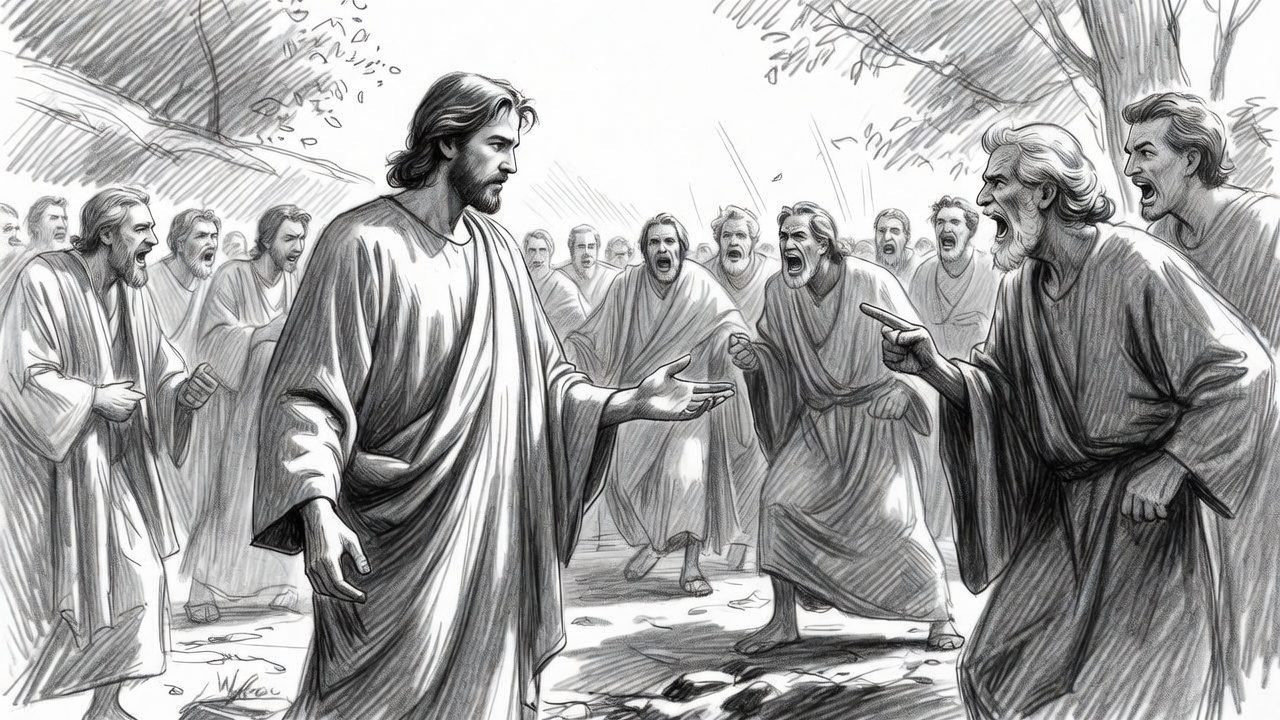
Jesus has been teaching in the temple in Jerusalem. The religious leaders are furious with Him. They have already accused Him of many things. Now the argument turns personal. Jesus makes the boldest claim in the whole Bible. The leaders understand every word of it.
As you read, hold this: Jesus claimed God’s own name, and everyone understood exactly what He meant.
Context A fight in the temple
This argument had been building all day. Jesus told the crowd that the truth would set them free (John 8:32). The leaders in this scene are called “the Jews” in the Bible text. That means these leaders, not the Jewish people as a whole. They were furious. They had already claimed Abraham as their father, then even God Himself. Jesus said their actions proved otherwise. That is where today’s passage picks up, right in the middle of the fight.
John 8:48–51 (BSB)
⁴⁸ The Jews answered Him, “Are we not right to say that You are a Samaritan and You have a demon?” ⁴⁹ “I do not have a demon,” Jesus replied, “but I honor My Father, and you dishonor Me. ⁵⁰ I do not seek My own glory. There is One who seeks it, and He is the Judge. ⁵¹ Truly, truly, I tell you, if anyone keeps My word, he will never see death.”
They cannot answer Jesus, so they insult Him instead. Jesus does not fight back. He does not defend His own name. He points to His Father instead.
Then He makes a huge promise. Whoever keeps His word, meaning holds onto it and obeys it, will never see death. Not “will live a long life.” Never see death at all.
John 8:52–56 (BSB)
⁵² “Now we know that You have a demon!” declared the Jews. “Abraham died, and so did the prophets, yet You say that anyone who keeps Your word will never taste death. ⁵³ Are You greater than our father Abraham? He died, as did the prophets. Who do You claim to be?” ⁵⁴ Jesus answered, “If I glorify Myself, My glory means nothing. The One who glorifies Me is My Father, of whom you say, ‘He is our God.’ ⁵⁵ You do not know Him, but I know Him. If I said I did not know Him, I would be a liar like you. But I do know Him, and I keep His word. ⁵⁶ Your father Abraham rejoiced that he would see My day. He saw it and was glad.”
To them, the promise sounds crazy. Abraham died. Every prophet died. So their question finally comes out plainly: Who do You claim to be?
Jesus answers by reaching back even further than Abraham. He says Abraham himself was glad, long before Jesus came, just to look forward to this very day. Abraham was not Jesus’s rival. Abraham was looking forward to Him all along.
John 8:57–59 (BSB)
⁵⁷ Then the Jews said to Him, “You are not yet fifty years old, and You have seen Abraham?” ⁵⁸ “Truly, truly, I tell you,” Jesus declared, “before Abraham was born, I am!” ⁵⁹ At this, they picked up stones to throw at Him. But Jesus was hidden and went out of the temple area.
Word study "I am": egō eimi (John 8:58)
Greek: ἐγὼ εἰμί (egō eimi), pronounced eh-GO ay-MEE. Strong’s G1473 + G1510.
It simply means “I am.” But these are the same words God used for His own name at the burning bush. God told Moses, “I AM has sent me to you” (Exodus 3:14). That is the very name Jesus reached for here. Jesus did not say, “I existed before Abraham.” He said, “I am,” using God’s own name for Himself.
The leaders hear a math problem: You are not fifty. How have You seen Abraham? Jesus answers with something far bigger than age: before Abraham was born, I am.
Nobody in that courtyard missed it. They knew exactly what those two words meant. So they picked up stones. That was the punishment for claiming to be God when you are not.
But it was not Jesus’s time yet. He simply walked out, unharmed, right through the crowd. No one could take His life before He was ready to give it.
Study notes The name at the burning bush
Long before this day, Moses asked God His name. God gave one answer, and it became the most sacred name in the whole Bible.
"God said to Moses, 'I AM WHO I AM. This is what you are to say to the Israelites: I AM has sent me to you.'" Exodus 3:14 (BSB)
When Jesus said “I am” in the temple, He was not being clever with grammar. He was reaching all the way back to Moses and claiming that same name for Himself.
Personal Application
-
Jesus said plainly that He is God. Do you believe He was telling the truth?
-
Abraham was glad, long before Jesus came, just to look forward to Him. What helps you feel glad about Jesus today?
Pray to Close
The central truth: Jesus did not just speak for God. He used God’s own name for Himself, and everyone understood it.
Praise: praise Jesus for being exactly who He said He is, the eternal I AM, wrapped in a human life.
Confess: confess any doubt that keeps Jesus smaller in your mind than He really is.
Ask: ask for faith to believe the claim the crowd could not accept.
Decision of the day
Today’s decision: Today I will say, out loud or quietly, one true thing I believe about who Jesus is.
Worship for Today
Yahweh, Great I Am · Hillsong Worship
This modern worship song takes the name God gave Moses at the burning bush and sings it straight to Jesus. It calls Him holy, worthy, and unshakable: the same great I AM who stood in the temple that day and would not back down. Sing it as your own answer to the stones the crowd never got to throw.
Listen: