Pray to Begin
Ask: ask the Holy Spirit to show you your deepest need today. It may not be the one you think.
Give thanks: for friends who carry us to Jesus when we cannot get there on our own.
Confess: tell God plainly about anything standing between you and Him. Today’s story shows what He does with it.
Today’s Passage: Mark 2:1–12
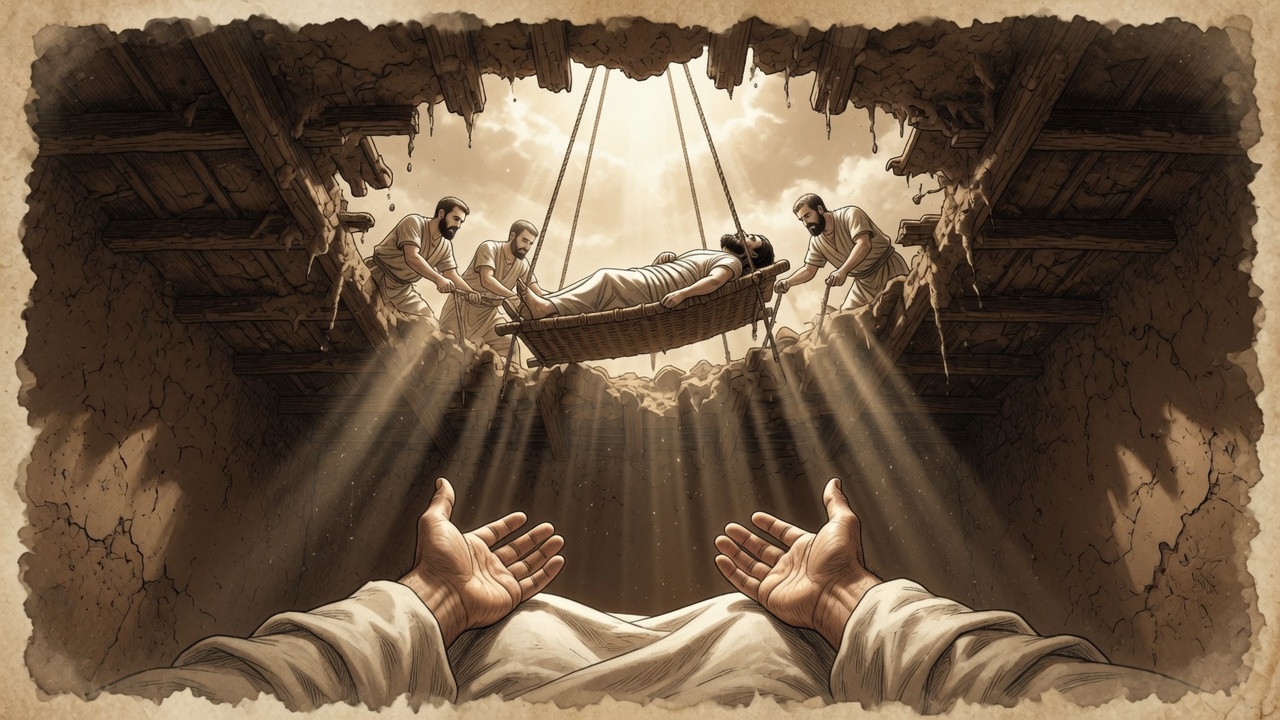
Jesus is home in Capernaum, and the house is packed. Four men arrive carrying a fifth man on a mat. The door is blocked, so they go up: through the roof. What Jesus says to the man they lower down surprises everyone.
As you read, hold this: Jesus forgives first. The deepest healing is the one we cannot see.
Context Roofs, mats, and scribes
Houses there had flat roofs made of wooden beams, packed dirt, and straw, with stairs on the outside. That is why four determined men could really dig through one. Many people back then believed that bad sickness meant bad sin somewhere. And the scribes, the religion experts, believed one thing that is exactly right: only God can forgive sins. Hold onto that. It makes what Jesus says next either a terrible lie or the best news in the world.
Mark 2:1–5 (BSB)
¹ A few days later Jesus went back to Capernaum. And when the people heard that He was home, ² they gathered in such large numbers that there was no more room, not even outside the door, as Jesus spoke the word to them. ³ Then a paralytic was brought to Him, carried by four men. ⁴ Since they were unable to get to Jesus through the crowd, they uncovered the roof above Him, made an opening, and lowered the paralytic on his mat. ⁵ When Jesus saw their faith, He said to the paralytic, “Son, your sins are forgiven.”
Word study "Forgiven": aphiēmi (Mark 2:5)
Greek: ἀφίημι (aphiēmi), pronounced af-EE-ay-mee. Strong’s G863.
The word means to send away, to let something go so that it is gone. When Jesus says your sins are forgiven, He does not mean “let’s ignore it.” He means the sins have been picked up and carried off. Forgiveness is removal, not politeness.
Four men decide their friend is getting to Jesus today. No crowd will stop them. When the door fails, they take the roof.
Mark says Jesus saw their faith. Faith here is not a private feeling. You can watch it. It digs through a roof.
Then the surprise. The man came for his legs. Jesus speaks to his sins first: Son (a warm, family word) your sins are forgiven. Aphiēmi: sent away. Gone. Jesus sees deeper than anyone else in the room. Before this man walks anywhere, he needs to be right with God. So do we all.
Mark 2:6–9 (BSB)
⁶ But some of the scribes were sitting there and thinking in their hearts, ⁷ “Why does this man speak like this? He is blaspheming! Who can forgive sins but God alone?” ⁸ At once Jesus knew in His spirit that they were thinking this way within themselves. “Why are you thinking these things in your hearts?” He asked. ⁹ “Which is easier: to say to a paralytic, ‘Your sins are forgiven,’ or to say, ‘Get up, pick up your mat, and walk’?”
The scribes never say a word out loud. Jesus answers them anyway.
And notice: their theology is correct. Only God can forgive sins. The question they will not ask is the big one: what if God is standing right in front of them?
Jesus’ question is sharp. Anyone can say “your sins are forgiven”; nobody can check it. But “get up and walk” can be checked on the spot. So Jesus offers proof you can see for a gift you cannot.
Mark 2:10–12 (BSB)
¹⁰ “But so that you may know that the Son of Man has authority on earth to forgive sins…” He said to the paralytic, ¹¹ “I tell you, get up, pick up your mat, and go home.” ¹² And immediately the man got up, picked up his mat, and walked out in front of them all. As a result, they were all astounded and glorified God, saying, “We have never seen anything like this!”
So that you may know. The healing is mercy for the man. It is also proof for everyone watching. The working legs prove what eyes cannot see: Jesus has God’s own authority to send sins away, right here on earth.
The man walks home carrying the mat that used to carry him. The crowd praises God. And the day’s point walks out with them: the greatest thing Jesus does for a person is the thing no one can see.
Study notes Only God forgives: Isaiah says so
- Faith that carries. Jesus saw their faith, the four friends’. Nobody gets to Jesus all alone.
- The order of the gifts. The man came for his legs. Jesus started with his soul.
"I, yes I, am He who blots out your transgressions for My own sake and remembers your sins no more." Isaiah 43:25 (BSB)
Personal Application
-
Whose “mat” could you help carry? Who needs you to bring them to Jesus: in prayer, in kindness, in an invitation?
-
When you pray, do you bring God your problems but keep your sins out of the conversation? What would change if you let Him start there?
Pray to Close
The central truth: Jesus forgives first, because the deepest healing is the one we cannot see, and He alone can send sins away.
Praise: the Son of Man, who proves His unseen mercy with power we can see.
Confess: the sins you have been carrying around as if forgiveness were not offered. Hand them over to be sent away.
Ask: for faith like the four friends had, faith that carries someone else toward Jesus.
Decision of the day
Today’s decision: I will pray for one person by name today, carrying them to Jesus the way the four friends carried their friend.
Worship for Today
His Mercy Is More · Matt Boswell & Matt Papa / Keith & Kristyn Getty
This modern hymn sings today’s promise: our sins are remembered no more, and God’s mercy outruns them all. It is the song of the man on the mat: what Jesus sends away is gone, and what He gives is more than we came asking for.
Listen: